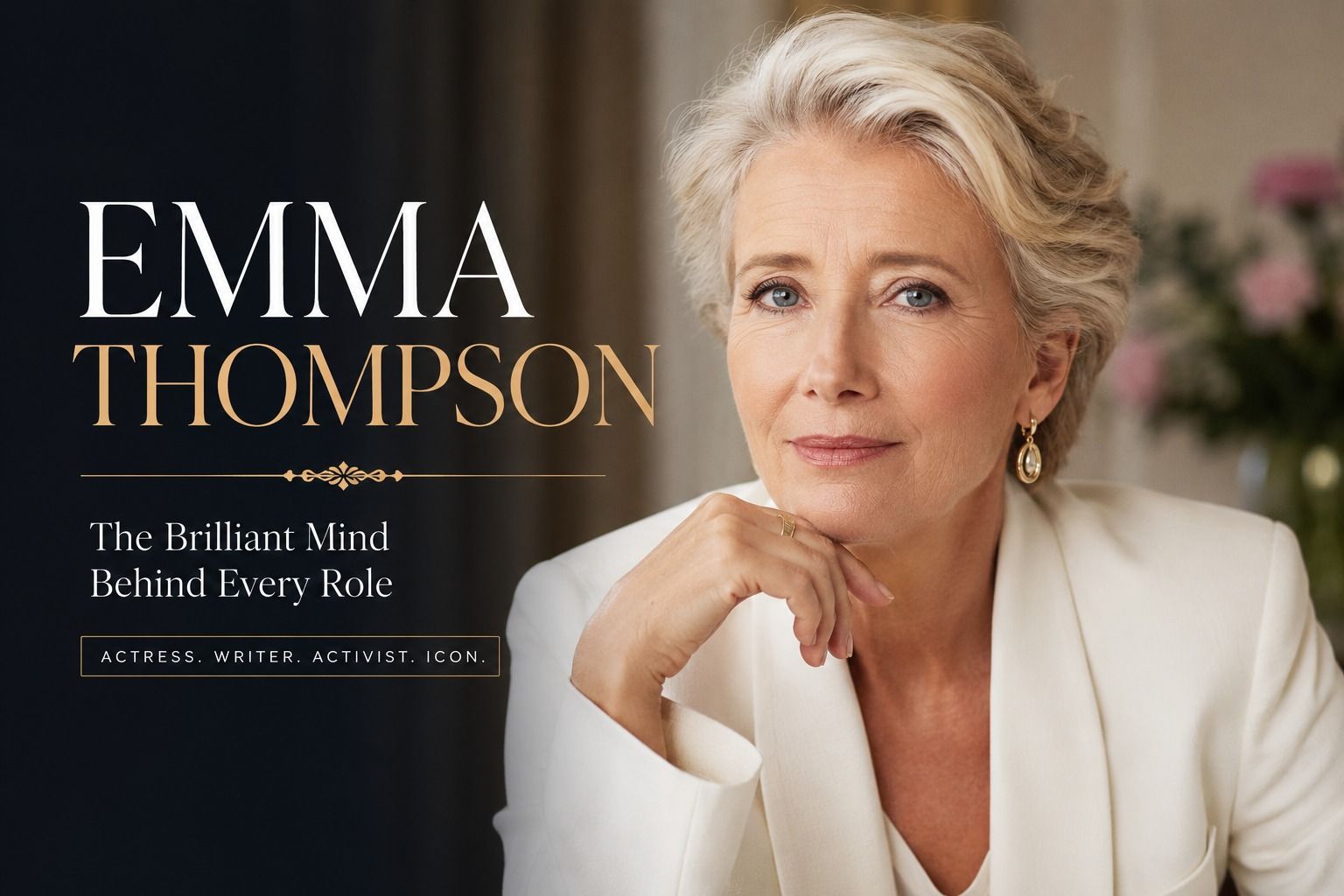
You know that rare feeling when an actor’s performance stays with you for days? It’s because they didn’t just act—they told the truth. Emma Thompson has delivered that truth for over four decades, carving a path few artists dare to walk. From period dramas that defined a generation to bare, emotionally raw modern stories, she commands the screen with rare intelligence. Yet acting is only one chapter. She writes scripts that slice through pretense and raises her voice for human rights with a fire that demands attention. This guide maps every corner of that remarkable world.
What Transformed Emma Thompson Into a Comedy Powerhouse?
Fresh audiences met her through the 1980s sketch show Alfresco, alongside Stephen Fry and Hugh Laurie. That fearless environment rewarded quick wit and perfect timing. Her later return to comedy in Love Actually proved her skill cuts across every genre. She crafts humor from vulnerability, making you laugh while your heart breaks just a little.
- Alfresco built the foundation for her sharp, literate comedic voice.
- The BBC series Tutti Frutti earned her a BAFTA for Best Actress.
- Her Love Actually scene, crying to Joni Mitchell, stands as a masterclass in tragicomedy.
The Early Stage Work That Sharpened Her Craft
Stage lights revealed a young performer of extraordinary discipline. Touring with Kenneth Branagh’s Renaissance Theatre Company pushed her into Shakespeare’s most demanding roles. Playing Helena in A Midsummer Night’s Dream and the tortured title character in Look Back in Anger built a backbone of theatrical excellence. Live audiences demand unshakeable focus, and those nights forged an actor who never lets a single beat ring false.
How the Merchant Ivory Partnership Created Screen Magic
Merchant Ivory Productions understood the power of restraint. Emma Thompson became their ideal interpreter, turning the corseted heroines of E.M. Forster into breathing, conflicted women. She doesn’t perform period dialogue; she inhabits it, making century-old language feel like a spontaneous thought. This partnership yielded some of her most luminous early film work, casting a template for literary adaptation that studios still chase.
Howards End and the Oscar That Changed Everything
Margaret Schlegel walks through a garden of social collapse, and you feel every tremor of her hope. Howards End (1992) demanded a performance of profound interior depth, and Emma Thompson delivered a character etched in quiet defiance. The Academy recognized that fire, awarding her the Best Actress Oscar. Suddenly, a classically trained British performer held the global spotlight, and she used it to demand richer, more complex stories for women.
The Screenwriting Triumph of Sense and Sensibility
Adapting Jane Austen terrifies most writers. Emma Thompson spent five years crafting a screenplay that preserved the novel’s sardonic bite while unleashing its volcanic emotion. She won the Academy Award for Best Adapted Screenplay—still the only person to hold Oscars for both acting and writing. The film breathes because she understood that Elinor’s silence screams louder than any confession. Producer Lindsay Doran has spoken about those “years of painstaking drafts” that finally captured the book’s soul.
Why Her Dramatic Range Defies Easy Labels
Some actors master one register. Emma Thompson dominates a dozen. Watch her as the chilly, repressed Miss Kenton in The Remains of the Day, then immediately study her raw, open-wound performance in The Children Act. The connective tissue is a commitment to emotional honesty that bypasses ego. She makes high-strung barristers, dying poets, and bewildered mothers feel like people you have met, sharing a crowded bus with them, knowing their secrets.
- The Remains of the Day (1993): A masterwork of suppressed longing.
- Primary Colors (1998): A sharp, funny turn as a political spouse.
- Wit (2001): A devastating portrayal of a professor facing terminal illness.
- Saving Mr. Banks (2013): A prickly, wounded P.L. Travers brought to aching life.
A Complete Emma Thompson Filmography of Essential Watches
A chronological journey through her work reveals an artist who constantly evolves. Each decade pivots to a new challenge, refusing safe repetition.
| Year | Film | Role | Why It Matters |
| 1989 | Henry V | Katherine | First major screen role; luminous, playful command of language. |
| 1992 | Howards End | Margaret Schlegel | Best Actress Oscar; defines the Merchant Ivory legacy. |
| 1993 | The Remains of the Day | Miss Kenton | A masterclass in unspoken, heart-shattering emotion. |
| 1995 | Sense and Sensibility | Elinor Dashwood / Writer | Screenwriting Oscar; a perfect adaptation born from true literary love. |
| 2003 | Love Actually | Karen | Anchors the film’s emotional reality with a devastating, silent breakdown. |
| 2005 | Nanny McPhee | Nanny McPhee / Writer | Family film with sharp teeth and a huge, generous heart. |
| 2013 | Saving Mr. Banks | P.L. Travers | Fierce, unlikable, and deeply human; a biopic that resists easy comfort. |
| 2019 | Late Night | Katherine Newbury | A bracing, funny exploration of female ambition and late-career peril. |
| 2022 | Good Luck to You, Leo Grande | Nancy Stokes | A brave, nude performance dismantling taboos around aging bodies and desire. |
The Deep Bond With Activist Work and Social Justice
Emma Thompson does not believe art can afford to remain silent. She leverages her platform for refugees, standing in camps and speaking before policymakers with equal conviction. The Helen Bamber Foundation, where she serves as an ambassador, receives her tireless energy. Walking through a Syrian refugee camp, she sits on the ground with displaced women, listening to their stories for hours, refusing the detached pity of a distant celebrity. Greenpeace actions place her body directly in the path of environmental destruction, proving protest and performance spring from the same well of empathy.
Motherhood, Marriage, and the Private World Behind the Fame
Gaia Romilly Wise entered her life in 1999, reshaping every priority. Adopting a son, Tindyebwa Agaba, a former child soldier from Rwanda, expanded her understanding of love as a revolutionary act. Her marriage to actor Greg Wise thrives on shared creative projects and a fierce mutual respect for privacy. This grounded, messy, beautiful family life supplies the emotional reserves she pours back into her work, shielding her from an industry that often devours its own.
What Happens When Emma Thompson Speaks About Climate Change?
She speaks with the precision of someone who reads the scientific reports. Flying to the Arctic with Greenpeace, she witnessed ice melt that charted a terrifying future. She channels that terror into clear, actionable language, avoiding the vague platitudes that plague celebrity activism. For her, the climate crisis is a human rights crisis, hitting the world’s most vulnerable populations first. She bought a piece of land in Scotland to rewild it, an act of quiet, stubborn hope.
The Voice of Sybill Trelawney and Other Iconic Supporting Turns
Professor Trelawney peers through her enormous glasses in the Harry Potter series, trembling with theatrical eccentricity. It is a small part played with gigantic commitment. Emma Thompson wrings every drop of comedy from the role while hinting at genuine psychic pain. You see the same scene-stealing brilliance in An Education, where a single, cutting monologue as a headmistress reframes the entire moral conflict of the film.
Writing Powerful Roles for Women Over 50
Hollywood discards women at an invisible boundary line. Emma Thompson demolishes that line. She writes scripts that demand complexity for older female characters, refusing the bland grandmother or the nagging mother-in-law. Her screenplay for Nanny McPhee reimagined the magical caregiver as an agent of discipline and transformation. She pushes harder with each project, telling the Belfast Telegraph that “writing is the only way to control the narrative, to force the industry to see women my age as they truly are—complicated, sensual, and very much alive.”
How She Chooses Projects That Challenge the Audience
The woman who played a repressed Edwardian housekeeper now portrays a widow hiring a sex worker in Good Luck to You, Leo Grande. Nothing about that trajectory suggests playing it safe. She chases scripts that ask difficult questions about intimacy, power, and dignity. Studios offer empty spectacle; she counters with human-scaled stories that demand you lean in, question your biases, and leave the cinema altered.
Frequently Asked Questions
How many Oscars has Emma Thompson won?
She holds two Academy Awards. She won Best Actress for Howards End in 1993 and Best Adapted Screenplay for Sense and Sensibility in 1996, making her the only artist to win in both the acting and writing categories.
What is Emma Thompson’s most famous role?
Her portrayal of Karen in Love Actually reached enormous global audiences and remains deeply beloved. However, critics often point to her Oscar-winning turn in Howards End or the emotionally raw Elinor Dashwood in Sense and Sensibility as the defining performances of her career.
Has Emma Thompson written any books?
Yes, she has authored the Nanny McPhee books and published a deeply personal diary titled The Sense and Sensibility Screenplay & Diaries, which chronicles the exhausting, hilarious process of filming the Austen adaptation and navigating her divorce.
What charities does Emma Thompson support?
She works closely with the Helen Bamber Foundation, supporting survivors of human trafficking and torture. She also champions Greenpeace’s environmental campaigns and ActionAid’s work on global poverty and women’s rights.
Did Emma Thompson really go to the Arctic?
Absolutely. She traveled with Greenpeace aboard the ship Arctic Sunrise to document melting sea ice. The journey informed her fierce public advocacy, where she connects Arctic destruction directly to the daily choices made by governments and corporations.
What is Emma Thompson doing now?
She continues to select challenging film projects that defy ageist expectations while writing new scripts and speaking at climate rallies. Her recent work in Good Luck to You, Leo Grande proves she is still taking the boldest risks of her career.
The Work Continues
You walk away from an Emma Thompson performance feeling more human, more awake to the world’s trouble and its stubborn beauty. She never stopped showing up—on soundstages, in protest lines, at her writing desk—demanding better stories and a more just planet. Her filmography belongs to you now. Watch a film you haven’t seen, share her crucial message on climate justice, or donate to the Helen Bamber Foundation to directly aid survivors of human cruelty. Engage with her work, let it unsettle you, and then go do something useful with that energy.